
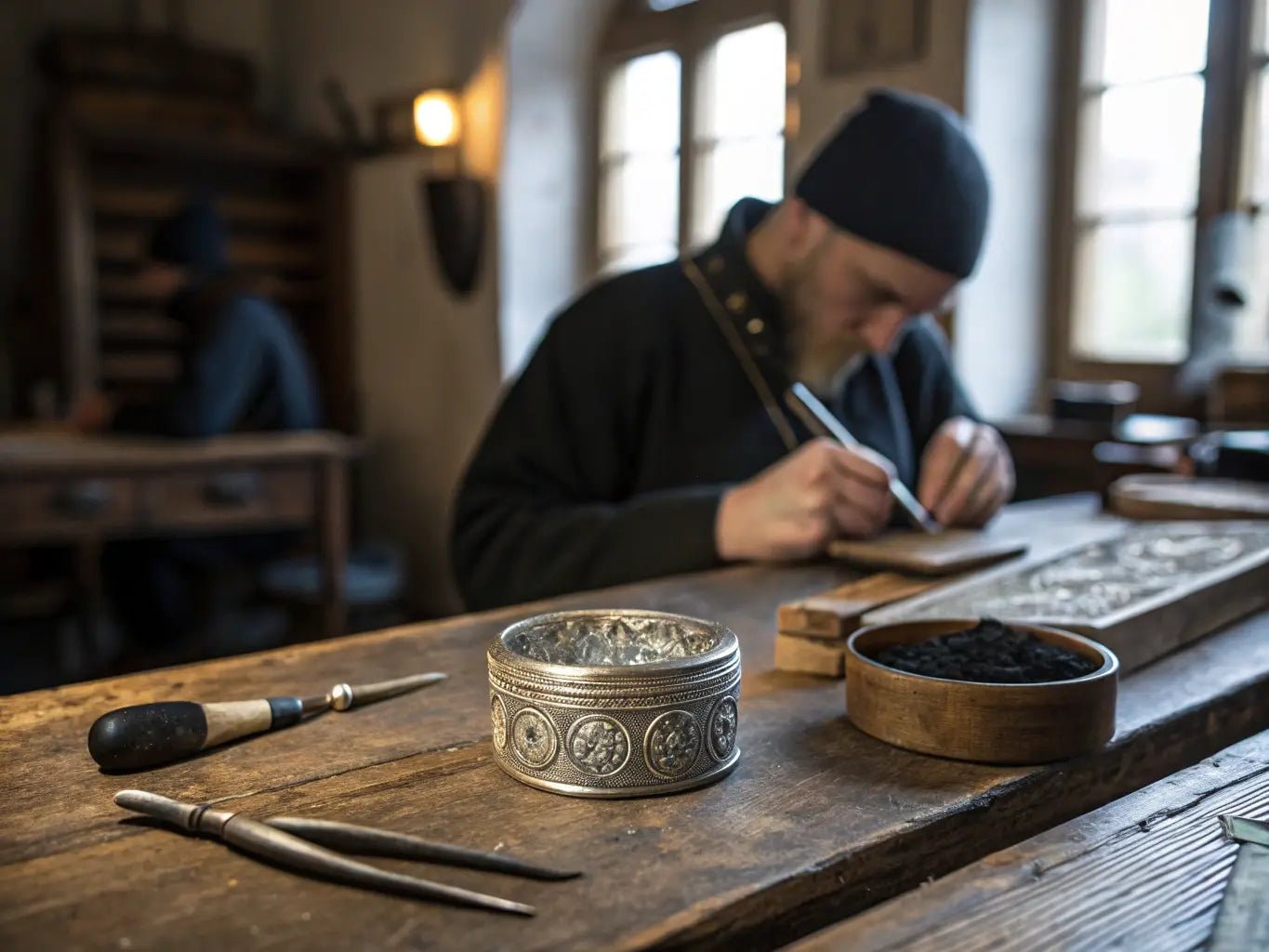
What looks like ink poured into silver is one of the most sophisticated finishing techniques in metal art. Niello silver thrives on the contrast between deep black ornaments and brightly polished precious metal—and on the fact that these lines are not painted on, but rather seated within the metal. In Western Europe, the technique has all but disappeared today. In Veliky Ustyug in the Russian north, however, it is still cultivated in all its depth.
This article explains what niello is, where it comes from, how a piece is created—and how you can recognize genuine niello work.
What is niello? — The art of dark finishing
Niello (from the Latin nigellum, "the blackish") is a dark metal alloy that is fused into previously engraved lines. The result is deep black patterns that are permanently bonded to the silver and stand out sharply from the bright surface.
Unlike lacquer, galvanic coating, or glued-on embellishments, niello is not a decoration on the surface. The alloy is fused into the engraving—it sits inside the metal, not on top of it. This is why niello silver can be used and passed down for generations without the design fading or flaking off.
How niello differs from other techniques:
- Oxidation darkens the surface chemically and wears off over time. Niello sits inside the engraving and remains.
- Enamel is a vitreous flux on the surface and can chip if struck. Niello is part of the metal.
- Engraving alone creates fine lines that often look pale without contrast. Only niello brings the design to life.
- Galvanic processes such as rhodium or gold plating coat the surface and can wear away. Niello stays where it is.
The history of the niello technique
Niello is one of the oldest known metal finishing techniques. Bronze daggers with dark inlays dating back to Mycenaean Greece around 1600 BC have been preserved; the Romans used the technique for jewelry and utensils, and it experienced its first peak in the Byzantine Empire: church utensils, reliquaries, and jewelry were decorated with fine niello ornaments.
The path to Russia. Knowledge of the technique traveled via Byzantine trade routes to Kievan Rus', where silversmiths were already working with niello in the Middle Ages. Veliky Ustyug became a center of its own: the city's niello art has been documented in writing since 1683, and in the 18th century, it was considered the benchmark of Russian silver art—with a floral design language and a finesse in engraving that differed significantly from Western European schools.
A rare art today. In Western Europe, niello is barely practiced anymore. The process is time-consuming, requires years of experience, and cannot be shortened by machines. In Veliky Ustyug, the tradition has survived because it has been consciously passed down: in 1929, hereditary niello master Mikhail Chirkov founded a cooperative, thereby preserving family recipes, and in 1933 this became the "Severnaya Chern" artel—the modern-day SevChern manufactory.
How is niello silver created? — Around 15 manual work steps
A niello piece goes through around 15 work steps, and almost every one of them requires a decision that only experience can make. You can best understand them by following a piece through the workshop.
It starts with the metal. Fine silver is alloyed to create sterling silver and melted in an induction furnace at 1080 °C; each batch is checked in the laboratory. Only when the metal is right does someone draw the first line.
Then comes the design. The ornaments are not created on a computer, but on paper. To draw on the silver, it is matted with white gouache; the design is transferred to the piece via a fine layer of soot—the "kopat." The masters divide curves into sectors so that the final pattern appears closed and symmetrical.
Next, the engraving. Using a hardened steel burin, the engraver cuts V-shaped furrows into the silver—line by line, with no room for correction. If a line is not right, the master starts over. Only this depth gives the niello alloy enough hold later on.
The actual niello. The compound is a dark alloy; the exact mixture is the secret of every workshop and determines color and durability. The piece is first boiled in soda so that no grease interferes with the bond. Then, the master fuses the alloy into the engraving with an open gas flame at around 2000 °C, constantly moving the piece so that the lines are filled without bubbles.
Finally, the completion. Excess niello is removed—using strictly circular motions so that the hard crust does not scratch the silver. Where gold is desired, a master covers the remaining silver by hand with lacquer and gilds only the specific detail in 990-fine gold. The polishing creates the triple contrast of matte black, mirror finish, and gold. Before a piece leaves the works, quality control checks it after every step—at least seven pairs of eyes see every product. In the end, the hallmark confirms origin and silver content.
Why no machine can do this: Niello work is three-dimensional and irregular. How deep must this line be? How long should the flame stay on this exact spot? How much can the polishing remove without weakening the design? The master answers these questions in the moment—based on feeling and experience, not a program.
Perfect for: collectors, lovers of Russian silver art, special occasions
Material: 925 sterling silver with niello inlay, partly gold-plated
Production: around 15 manual work steps, Veliky Ustyug
Benefits: permanent contrast, abrasion-resistant, does not fade
Nielloa — our niello line from Veliky Ustyug
Nielloa is the name under which we offer these niello works of art in our shop. The manufacturer is the SevChern manufactory in Veliky Ustyug, which continues the local niello tradition and is recognized in Russia as a folk craft. The distinction is important to us: niello is the technique, SevChern is the manufacturer, and Nielloa is our line.
People instead of machines. Silversmiths, engravers, and niello masters work at the manufactory, many of whom spend their entire professional lives in the same workshop—knowledge is passed down through families there. Each master has their own signature style, and no stroke is the same as the previous one.
925 sterling silver as a base. The pieces are made of 925 sterling silver and bear the hallmark as a sign of authenticity. But the best certificate of authenticity is the piece itself: the master's signature, the polish, the weight in your hand.
The range. Nielloa includes not just jewelry, but a wide spectrum of silver objects: tableware and cutlery, silver bowls, wall art, accessories, and christening gifts—from small pendants to large bowls.
Expand and collect. Many motifs are available in several forms, so that cutlery or series can be expanded over the years. We are happy to check for you whether a specific piece can be reordered.
Identifying and caring for niello silver
Recognizing genuine niello. How do you distinguish genuine niello work from an imitation?
- Depth instead of surface: Genuine niello sits inside the engraving. If you run your fingernail over it, you feel that the black alloy fills the depression but does not protrude above the surface.
- Contrast and clarity: The boundary between black and silver is sharp. With blackened or oxidized silver, the transitions are often soft.
- Durability: Niello cannot be wiped or polished away. Oxidation, on the other hand, wears off over time.
- Hallmark: Genuine Nielloa pieces bear the 925 hallmark.
Care — easier than you think. Niello silver is easy to maintain. The black lines require no special treatment, and the contrast remains.
- Silver polishing cloth: Occasional polishing of the bright areas with a soft silver cloth keeps the shine fresh—with every polish, the contrast tends to become stronger.
- No dishwasher: Niello cutlery and tableware do not belong in the dishwasher. The detergents and high temperatures damage the silver. Hand washing with a mild dish soap is sufficient.
- No silver dips: Chemical silver cleaners can impair the niello contrast. Avoid aggressive cleaning agents.
- Storage: It is best to store items in a silver cloth or flannel bag to avoid scratches and excessive tarnishing.
Discover niello silver
Nielloa accessories — craftsmanship to wear
Flasks, business card cases, and writing instruments made of 925 silver with niello—each piece handcrafted in around 15 work steps.
To the collectionFrequently asked questions about the niello technique
What does niello mean?
Niello refers to a black metal alloy that is fused into engraved lines in silver or gold—and the technique behind it. The word comes from the Latin nigellum, "the blackish." In German, it is also called "niello technique" or "niello work."
Is niello the same as oxidized silver?
No. Oxidation is a chemical reaction that darkens the silver surface and wears off over time. Niello is a distinct alloy that is intentionally fused into engravings. It is permanent, abrasion-resistant, and does not lose its contrast.
Can niello decorations be produced by machine?
Genuine niello work cannot. Engraving, fusing, and polishing require a master's decision at every step—for instance, the temperature of the flame depends on the size and engraving depth of each individual piece. Mechanical processes produce a dark appearance at best, not a fused line.
What is the niello alloy made of?
A dark alloy. Every workshop guards the exact mixture as a secret. It determines the color—from gray-black to deep black—and the durability of the line.
Does niello fade over time?
No. Unlike oxidation or coatings, niello is fused with the silver. Surviving pieces from the 18th and 19th centuries still display the contrast today. With normal use and simple care, niello silver remains beautiful for generations.
Is niello silver suitable for daily use?
Yes. Niello cutlery and tableware are made for use, not just for display. The inlay is robust and abrasion-resistant. The only limitation: hand wash instead of dishwasher to protect the silver in the long term.
Can I reorder individual pieces or expand my set?
Often yes—many motifs are produced over long periods. We are happy to check for you whether a specific piece or motif is still available. Just contact us.
Table culture in 925 silver
Tableware and cutlery with niello
Cutlery, tableware, and serving pieces made of sterling silver, handcrafted—for a table that tells stories.
Discover tableware