
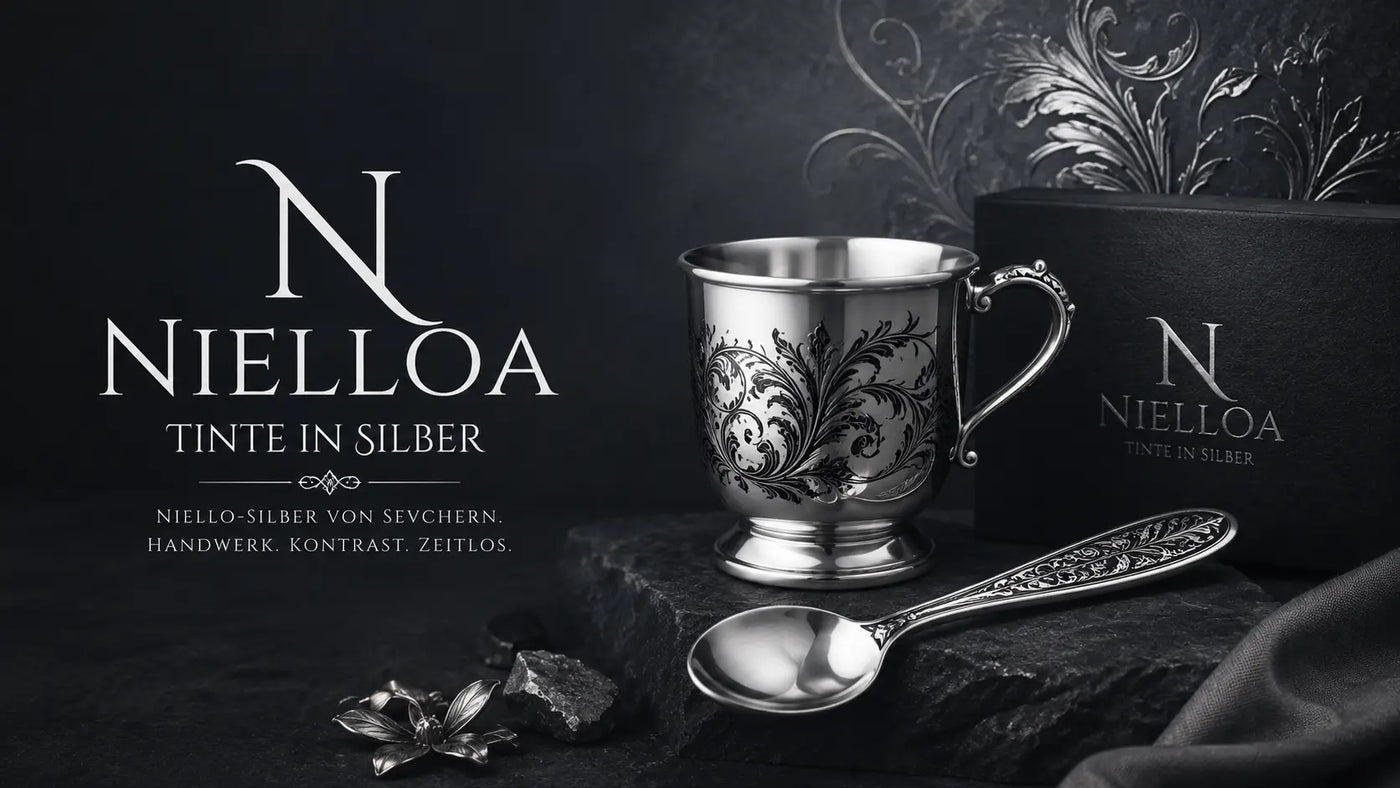
Niello is the art of permanently fusing a deep black metal alloy into engraved grooves in 925 sterling silver. The result is an iconic black-on-silver contrast that clearly distinguishes niello from enamel, oxide layers, and simple engraving. This page explains how niello is created, how to recognize genuine workshop quality, and what design language is possible with this technique.
Niello pieces from genuine master craftsmanship
Our curated Nielloa line brings together authentic niello works of art from Veliky Ustyug — tradition since 1683.
Discover the Nielloa collectionWhy niello is unmistakable
- Permanent bond: The black alloy is fused into the engraving — it does not merely sit on top, but is form-fitted and integrated.
- Precise temperature control: Each firing takes place within a narrow temperature window; deviations can discolor or crack the surface.
- Complex process: A masterpiece is created in many individual steps — alloying, pulverizing, engraving, filling, firing, lifting, grinding, polishing, inspecting.
- Rare mastery: In Europe, this perfected technique is mastered to workshop quality in only a few places — knowledge passed down through generations.
The technique at a glance — "black script" in silver
- Creating the alloy: Silver, copper, and lead are combined with sulfur to form a niello alloy.
- Granulating & milling: The solidified alloy is crushed and ground into a fine powder.
- Engraving the motif: The design is cut deeply into the silver — depth and geometry determine the final black intensity.
- Filling: The niello powder is applied as a paste into the engraved grooves and fixed.
- Firing: Under controlled heat, the alloy fuses permanently with the base metal.
- Lifting & smoothing: Excess material is removed; controlled, plane-parallel work is essential.
- Grinding & polishing: Niello grinds faster than silver — therefore it must be polished in stages to a high gloss without "softening" the contours.
- Quality control: Edges, transitions, luster, line precision, and motif sharpness are inspected individually.
Clear distinctions: Niello, engraving, enamel
- Niello: Metallic, deep-black alloy in the recesses, polishable, highly contrasted, and very durable.
- Pure engraving: Lines without filler; fine, delicate, without color contrast — ideal for monograms and lettering. More in our engraving service.
- Enamel: Glass-like layer on the metal; decorative, colorful, technically a separate discipline of finishing.
Historical depth in brief
The idea of filling engravings with a black metal mixture is related to ancient Near Eastern and Byzantine traditions. Over centuries, the technique was refined — lower melting points, better alloy recipes, finer engravings. In Northeastern Europe, an independent design language developed from this: floral arabesques, ornamental bands, animal motifs, iconic cityscapes. The niello art of Veliky Ustyug has been documented in writing since 1683; it reached its peak in the 18th century, was revived in the 20th century by Mikhail Chirkov — today, the SevChern workshop (Severnaya Chern, founded in 1933 as an artel) is the most important guardian of this tradition.
Design language: Lines, fields, contrasts
- Geometry & grip: Engraving grooves provide support for the niello mass; line width, depth, and angle of curvature influence the black intensity.
- Motif worlds: Floral patterns, heraldry, zodiac symbols, Orthodox ornamentation, architectural motifs — each motif requires its own engraving and firing strategy.
- Triad of precious metals: Silver base, niello black, and partial gilding create visual depth without clutter.
Identifying quality — Checklist for connoisseurs
- Transitions: Clean, sharp edges between silver and black without bleeding.
- Luster: Even high gloss; the black should not look chalky or matte when wiped.
- Line coherence: Continuous patterns without porous filling zones or "holes" in large areas.
- Hallmarking & origin: 925 stamp and maker's mark; for imports, official assay marks may be present.
Care & handling
- Cleaning: Hand wash with mild detergent, use a soft cloth; no scouring pads.
- Polishing: Use gentle silver polishing cloths; avoid aggressive dipping baths.
- Daily use: Niello is robust; however, avoid hard impacts and heavy grinding.
Detailed care instructions with all steps can be found at Care instructions for 925 silver.
Symbolism & meaning
Silver stands for purity, protection, and constancy. In niello objects, this symbolism combines with everyday practicality and an unmistakable aesthetic. This is why niello pieces are particularly suitable as gifts for life moments such as births, baptisms, weddings, or anniversaries — pieces intended to become heirlooms.
Niello and engraving — a special combination
A specialty offered only by SevChern for niello pieces: blackened engraving. An existing engraving is subsequently oxidized (blackened) so that the lines shine dark within the silver — the engraving thus picks up the look of the niello and harmonizes with the piece instead of just sitting on top. We offer this method exclusively for SevChern niello pieces. More details in the engraving service.
FAQ — Niello in 925 silver
How do I recognize genuine niello?Genuine niello sits in the engraving, appears metallic, and is polishable. Paint sits on top, and oxide is uniformly gray without its own luster. When looking at a genuine niello piece against the light, you will see that the black has its own metallic depth that appears to shift slightly with every movement.
Can niello flake off?
The alloy is permanently integrated with the silver — chemically and physically fused, not glued. However, mechanical force or improper grinding can cause damage. With normal use and proper care, niello remains stable for generations.
Is niello suitable for tableware?
Whether a piece is intended for use with food and beverages is stated in the respective product description. Observe the manufacturer's instructions for the specific item — for some pieces, use only with cold items is recommended.
How does niello harmonize with gilding and enamel?
Niello provides depth and contour; gilding adds highlights; enamel brings color. All three finishing techniques are sometimes combined on the same piece — the Veliky Ustyug workshop school has mastered this for centuries. Important: Enamel is applied separately; it is an independent glass finishing process and not a niello procedure.
What distinguishes Nielloa from niello?
Niello is the technique itself — the centuries-old method of fusing black alloy into silver. Nielloa is our brand name for genuine niello works of art from the SevChern workshop. At premiumgeschenk.de, we use the term Nielloa to identify curated pieces from Veliky Ustyug — clearly distinguishing them from industrial silver blackening or oxide imitations. More at Nielloa — Ink in Silver.
Gifts with style & soul
Niello pieces from genuine master craftsmanship: tradition from Veliky Ustyug, curated for life's occasions.
Discover Nielloa