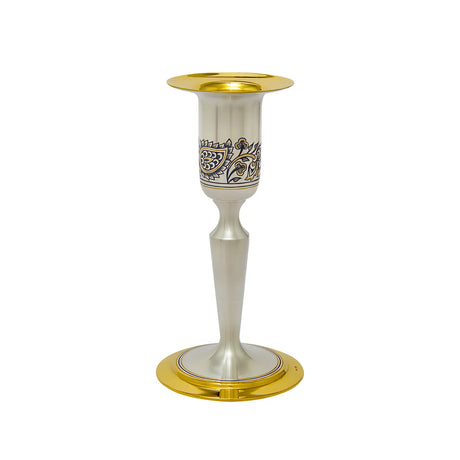
Of all industrial metals, silver has the highest reflectivity for visible light—over 95 percent. Before electrification, a silver candlestick was therefore not a luxury, but a functional tool: it reflected the light of a single candle back into the room, making the evening brighter. This effect has remained.
Here you will find silver candlesticks and candelabra made of solid 925 sterling silver: single-flame for use in pairs, or multi-armed as candelabra for the center of the table. Most originate from Padua, one from the Nielloa line—and each makes a gift that will return to the table for every celebration.
The construction of a candlestick
Three parts determine every form. The nozzle holds the candle and usually carries a drip tray underneath. The shaft connects it to the base, which supports and weights the whole piece.
The character of a piece can be recognized by the distribution of its ornament. If it sits on the nozzle and base and leaves the shaft plain, the calm shaft leads the eye upward to the flame—and one grips the candlestick where it is smooth. If the ornament continues throughout the shaft, the surface refracts the light into many small reflections: the flame flickers within the metal rather than reflecting as a single surface.
Single-flame candlestick or multi-armed candelabra
The single-flame candlestick is traditionally effective in pairs—placed to the left and right of a floral arrangement, at the ends of a table, or flanking items on a sideboard. Symmetry is half the effect.
The candelabra combines multiple arms in one piece. It replaces a pair with a focal point and bears two, three, or more flames at the same height. On round tables and in the center of a room, it is the more appropriate form because it presents the same image from all sides.
On long tables, staggering works well: taller pieces in the center, lower ones toward the ends. This keeps the line of sight across the table clear, and the light comes from above.
Which height for what purpose
On a set table, a sensible height begins at approximately 30 cm—any lower and you would be looking into the flame instead of at the person opposite you. Between 39 and 47 cm, the light sits well above the eye level of those seated and falls from above, like a small chandelier.
On a sideboard, console, or mantelpiece, the height plays a different role: there, it is about the relationship to the wall and to what is standing next to it.
What is available here
Single-flame, for use in pairs:
Multi-armed, as a centerpiece for a table: the Ottagonale with two arms and the Inglese with three flames.
Large candelabra from the Signature line, approx. 65 to 66 cm, with arms on multiple levels:
Chanukkiot for the Festival of Lights, nine nozzles with an elevated shamash: four versions from approx. 65 to 76 cm, which you can find here and under Judaica in 925 silver. Their design follows their use, not table decoration.
Candelabra or Chanukkiyah — the difference
Both hold multiple lights, and both can have nine. Still, they should not be confused.
In a Chanukkiyah, eight nozzles stand side by side at exactly the same height, and a ninth is placed higher: the shamash, used to light the others. This arrangement follows its use—the eight lights should be of equal rank; the ninth is not one of them.
A candelabra, by contrast, distributes its arms around the shaft, often on several levels. No single light is highlighted. It is a table candlestick, not a ritual object—and the nine-flame version among them is therefore not a Chanukkiyah, even if the number of lights is the same.
The four Signature candlesticks belong to a larger line that also includes trays, platters, and ritual objects—anyone wanting this signature style across the entire table will find it there.
The signatures
Zaramella Argenti from Padua has stood for Italian classicism since 1948—clear forms, clean polishing, crafted by the third generation. The house's candlesticks range from restrained models with polished zones to the Signature line, whose shafts are hand-chased across the entire surface, partly with sculptural acanthus leaves.
Nielloa introduces a different tradition: Niello silver, in which a black inlay is melted into engraved lines, ground flush, and polished—like ink in silver. The contrast between shining silver and deep black is particularly effective in candlelight because the flame only hits the raised surfaces. More can be found in the Nielloa collection.
Chased — what this means
Chasing means that a pattern is driven into the silver by hand with punches, strike by strike. Unlike stamping, which is created under a press in one operation, chased work has real depth—the vines cast shadows, and no section repeats the previous one exactly.
On a slender, tapering shaft, this is the more difficult task: the motif must become narrower toward the top without appearing compressed. Those who look closely will recognize the handiwork in this.
The recurring motifs come from the repertoire of forms that the Italian Renaissance adopted from antiquity: the acanthus leaf with its curled tips, the volute as a coiled scroll at the transition from shaft to base, the beaded edge as a circumferential band of small half-spheres. In the Poppy model, a more recent motif is added: the ribbed capsule, which refracts the light in narrow strips.
Light that remains in memory
Candlelight marks occasions—Friday evening, a birthday, the dinner that is meant to be different from yesterday's. A silver candlestick makes this a recurring object: it stands on the table for every one of these evenings, for decades, and over time becomes part of the memory of them.
In many families, this is precisely the reason why a pair of candlesticks is passed down. It is not an object you replace when it gets old—the traces of wax and the darker tone in the crevices are what define it.
Engraving
Models with polished zones on the shaft or a smooth base rim can accommodate a monogram, a date, or two initials—for a pair, often one on each. Pieces worked over their entire surface do not have this area; there, the underside of the base remains as a discreet location. Because the surfaces are curved, we coordinate size and position in advance. Upon request, we will enclose a complimentary SilberVerse card—a specially composed 3–4 line verse regarding the occasion and names, in your preferred language, printed as a 15 × 10 cm photo card in a standard frame in silver, white, or black.
The right gift for major occasions
A pair of candlesticks is one of the few wedding gifts that will remain on the table for every celebration—for decades. For a silver anniversary, a move, a milestone birthday, or as a representative corporate gift. Because a pair can be split, two gift-givers can contribute one piece each. And during the Advent season, when candlelight is never missing from any table, a silver candlestick is the Christmas gift that is brought out again every year—for parents, for a couple in their first shared home, or for your own festive table. Further ideas can be found in the anniversary gifts and the gift ideas in 925 silver.
Care
By hand with warm water, mild detergent, and a soft cloth, then dry thoroughly. No dishwasher: cleaning salts attack silver.
Wax residue is best removed by placing the candlestick in a cool place for a short time—then the wax can be lifted off without scratching. Never work with a knife: silver is softer than steel, and every mark will remain. Tarnishing is not damage, but a reaction with sulfur in the air, and it is reversible with a silver cloth. The darker depth in chased crevices may remain—it gives the ornament its three-dimensional quality. More in the guide on the care of silver cutlery and silver tableware.
Frequently asked questions
Which candles fit?
Classic taper candles with a 22 mm diameter, the standard size in retail. For a slight undersize, a drop of wax in the nozzle helps.
Does the candlestick get hot?
Silver conducts heat well—the nozzle becomes noticeably warm, the shaft remains hand-warm. Let cool briefly before touching.
Can individual candlesticks be combined into a pair?
Yes, our candlesticks are listed individually. Contact us if both are to bear the same engraving.
Can different models be combined?
Within a line, yes—the same basic form in two heights results in an intentional staggering. Across different lines, it is worth looking at the base shape and ornament density.
Candlestick, candle holder, candelabra — what is the difference?
Candlestick and candle holder mean the same thing in everyday life: a holder for one or more candles. A candelabra is the term for a multi-armed candlestick that combines several flames on one base. Those wanting to frame a table in pairs should choose a single-flame candlestick; those seeking a focal point should choose a candelabra.
Solid or silver-plated?
All pieces in this category are solid 925 sterling silver—no silver plating.
You might also be interested in
To match the table, our silver trays, silver vases for floral arrangements in between, and our entire tableware & silver service.