
Why silver, why black? Two materials, one language
Anyone holding a piece of Niello silver for the first time almost always asks the same question: How does the black get into the silver? The answer leads to a craft older than most European royal houses – and one that today is alive in only a few workshops.
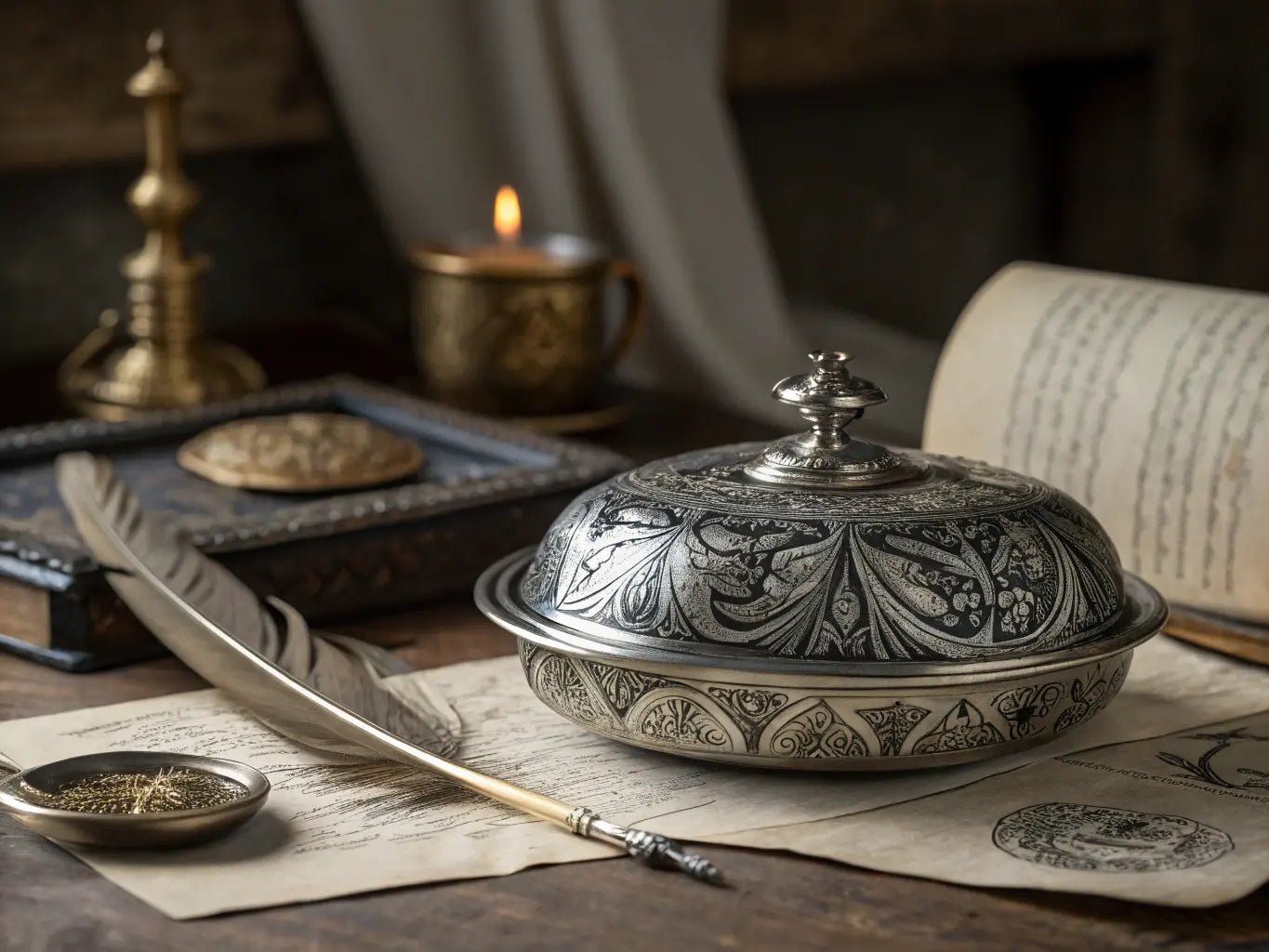
Niello is a black compound that is melted into engraved ornaments. The result is a contrast between shining silver and a deep black background, which makes every ornament stand out in relief. No paint, no varnish, no coating – but a compound that becomes part of the metal. You can find a detailed introduction to the technique in What is Niello?; here, we focus on the question behind it: why silver and black, of all things.
The material duet: Why silver and black belong together
925 sterling silver is the base material of every Niello piece. It combines purity with malleability – soft enough for the finest engraving, durable enough for generations. But it is only through the Niello that the true work of art emerges.
The black is not an opposite to the silver. It is its accomplice. Where silver forms the surface, Niello gives a voice to the depth. The engraved lines do not just become visible – they become readable. Ornaments that would look flat without the black background gain a depth through Niello that you can feel with your fingertips.
This interplay is not a design trend. It is a language that has been spoken for over a thousand years – in Byzantine churches, at the courts of the Russian Tsars, on the workbenches of the silversmiths of Veliky Ustyug. And today in the workshop that crafts our Nielloa collection.
The graver: Where precision meets experience
Before Niello even comes into play, the silver must be engraved. And engraving here is not work for machines, but a silent conversation between hand and metal. The most important tool is the graver made of hardened steel, often sharpened and adjusted by the engraver themselves. With it, the master cuts V-shaped furrows into the silver – deep and clean enough for the Niello compound to later anchor itself firmly within them.
Engraving requires controlled light to judge the depth of the cut, and a steady hand that only comes from years of practice. At SevChern, there are engravers who have done nothing else for decades; in some families, the craft goes back generations.
Discover hand-engraved Niello silver
Around 15 manual work steps – from design to the final polish.
Russian workshops: Where tradition still begins with soot
In the workshop, daylight falls on the workbenches; it smells of metal and concentrated silence. Hands, trained over many years, guide tools as if they were fountain pens. Here, they do not simply engrave – they tell stories.
The Niello tradition has a particular depth in Russia. Veliky Ustyug in the north is one of its historical centers; the Veliky Ustyug Niello tradition has been documented since 1683. The technique was not recorded in textbooks, but passed from master to apprentice: every grip, every turn, every angle of pressure is internalized through repetition. Our Nielloa baptismal gifts and accessories come from this workshop – from SevChern.
Around 15 work steps: From blank to masterpiece
Until a Niello piece is finished at SevChern, it goes through around 15 work steps. It begins with the silver itself: in the in-house foundry, fine silver is alloyed at 1080 °C to create 925 sterling silver. At the same time, the design is created on paper – artists like Olga Petrova draw the ornaments by hand, and a master transfers them sector by sector onto the curve of the object so that the pattern appears closed and symmetrical.
Then the engraving begins. The template is applied to the silver via a layer of soot, and the V-shaped furrows are created with the graver. For the blackening, the piece is first thoroughly degreased, then the master applies the Niello compound and melts it in an open gas flame at around 2000 °C. He must constantly move the workpiece so that the liquid Niello fills the lines without bubbles. The exact mixing ratio is guarded by the workshop as a secret.
After cooling, the Niello crust is ground off in strictly circular movements – at SevChern, this step is called Opilovka –, followed by gilding where desired, and finally polishing to a mirror finish, while the inside of the Niello deliberately remains matte. Quality control checks after every stage before proceeding. Because so many steps are done by hand, every piece bears the handwriting of the people who made it. Our series shares more about this, for example From blank to mirror and Secret 10: the OTK.
Good to know
✦ Material: 925 sterling silver from SevChern's own foundry
✦ Niello: dark compound, melted in an open flame
✦ Origin: Veliky Ustyug, Niello tradition since 1683
✦ Care: soft cloth or silver polishing cloth, no dishwasher
Why Niello has become rare in Western Europe
Niello was once widespread throughout Europe. From the goldsmiths of the Middle Ages through the Renaissance to the 19th century, the technique was part of European silver art. Then it became rare.
The reasons are multifaceted: industrialization displaced time-consuming manual techniques, wars interrupted master-apprentice chains, and post-war modernism favored clear, unadorned forms – Niello ornaments were suddenly considered old-fashioned. In Russia, the tradition survived in regional craft centers with a strong local identity that view craftsmanship not as nostalgia, but as a living culture.
This is precisely what makes our Niello collection special: it brings a finishing technique to us that only a few workshops have mastered – crafted by people who never gave it up.
Niello in comparison: how it differs from other techniques
To understand Niello, you have to know what it differs from. Because there are many ways to refine silver — but none achieve the same effect.
| Technique | Principle | Durability | Handwork |
|---|---|---|---|
| Niello | Black alloy melted into engraving | Permanent (metallurgical) | Handwork |
| Enamel | Glass melt on metal | High, sensitive to hard knocks | Depends on process |
| Oxidation | Chemical blackening of the surface | Limited (rubs off) | Machine possible |
| Engraving without filling | Lines cut into the metal | Permanent | Hand or CNC |
| Gilding | Gold layer on silver | High with fire gilding | Hand or galvanic |
The crucial difference: Niello is not a coating that could be applied and removed again. It forms a bond with the silver – just like ink with paper. The black is part of the metal, not just its surface. That is why our collector's pieces still look the same after decades as they did on the day they were made.
Niello silver as a gift
From baptism to anniversaries — pieces that last for generations.
From workbench to gift table: Niello as a gift
Anyone giving a Niello piece is giving not just an object, but a story: that of a craft older than most family traditions, and that of the people who spent many hours on this one single piece.
That is why Niello silver is particularly suitable for occasions where meaning matters: for baptisms, weddings, anniversaries, or as a special business gift. These are pieces that one does not use up, but passes on.
Whether as a piece of jewelry, as part of our coffee and tea service collection, or as a collector's item for the display cabinet – Niello silver combines everyday culture with craftsmanship.
Frequently asked questions about Niello silver
Why is Niello black?
Because the compound contains sulfur compounds of metals – and they are dark. When melted, it bonds with the silver and remains permanently black, while the surrounding silver is polished.
Is Niello silver maintenance-intensive?
No. Because the Niello is firmly bonded to the silver, it does not rub off and does not fade. A soft cloth or a silver polishing cloth is sufficient for care; Niello pieces do not belong in the dishwasher. The Niello itself remains black – that is its advantage over chemical oxidation.
Why is Niello so rare in Western Europe?
Industrialization, wars, and changing tastes interrupted the transfer of the craft from master to apprentice. In Russia, the technique survived in regional centers like Veliky Ustyug.
Can Niello pieces be engraved?
Often yes, but always upon request: Because Niello pieces are already fully decorated, we clarify every engraving request individually with the manufactory – such as whether there is space on the base or on a free, polished surface.