
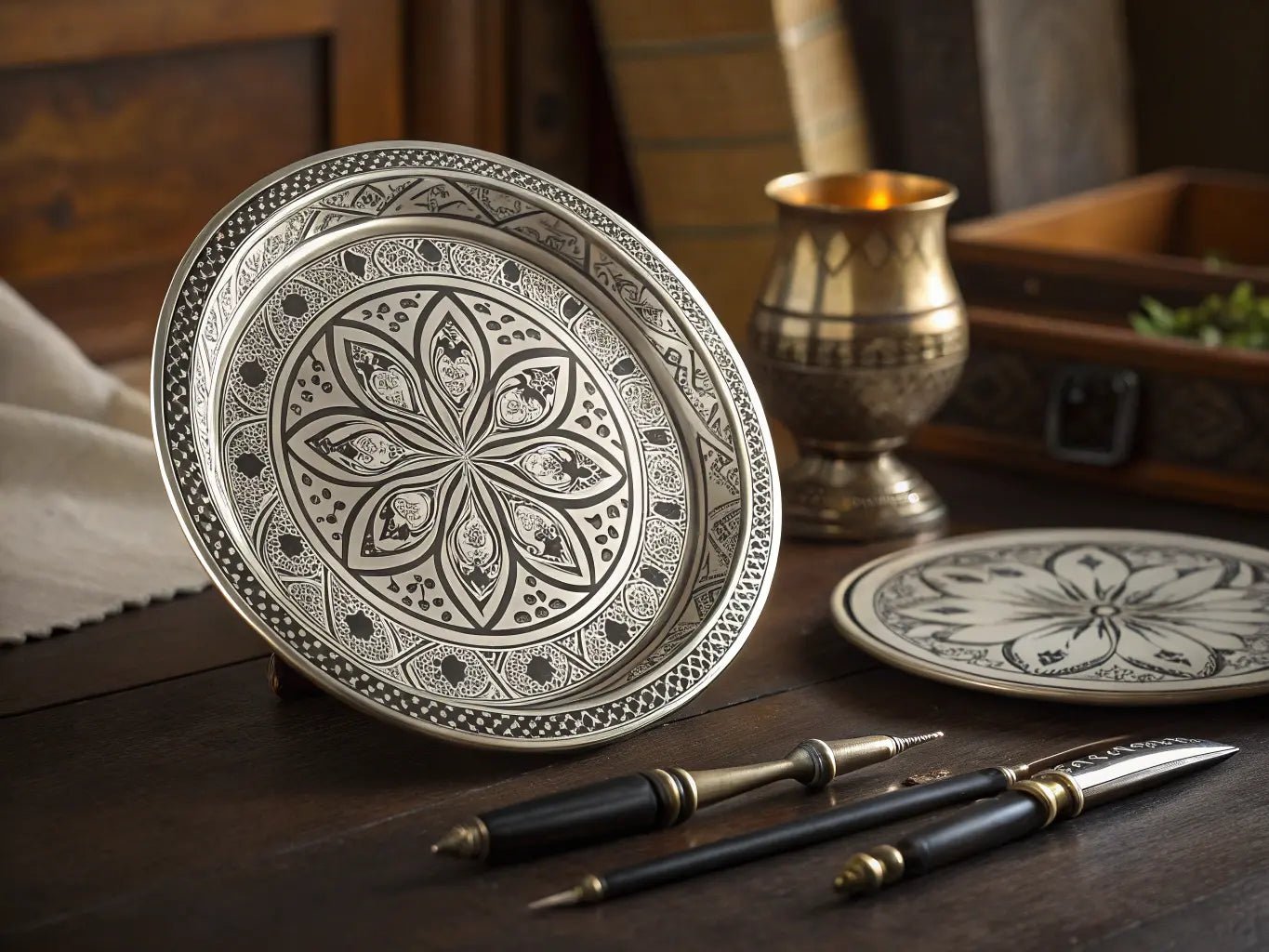
If a silver object makes you pause — if dark ornaments on bright metal create a depth that no photograph can quite capture — then you are likely holding a piece of niello silver. But what exactly is this technique, which hardly anyone in Europe still masters?
What is Niello? — Silver Art with a Dark Soul
Niello (from the Latin nigellum, "the black") is an embellishment technique for silver where a dark metal alloy of silver, copper, lead, and sulfur is melted into previously hand-engraved ornaments. The result is a permanent, deep black contrast on brightly polished sterling silver — an effect that neither fades nor flakes, because the dark mass is embedded in the metal, not on it.
When someone sees a niello piece for the first time, they often think of ink that has flowed into silver. In fact, the comparison is not far-fetched: like ink in paper, the niello alloy pulls into the engraved depressions and permanently bonds there with the base metal. The difference: ink fades. Niello endures for generations.
Definition: Niello is an inlay technique where a dark metal alloy is melted into engraved silver surfaces.
Origin: Antiquity (Egypt, Rome, Byzantium), developed into an art form in Russia from the 10th century onwards.
Material: 925 Sterling silver as the base, niello alloy of silver, copper, lead, and sulfur as the filling.
Special feature: The embellishment is permanent and abrasion-resistant — it withstands daily use for decades.
Niello in Brief — Facts and Characteristics
Before we delve deeper, here are the key points at a glance:
- Technique: Hand engraving + melting a dark alloy into the depressions
- Work processes: Each piece undergoes at least 15 individual steps — from raw form to engraving, alloy production and melting, to final polishing
- Durability: The dark ornamentation is firmly fused with the silver and cannot be rubbed off, washed off, or chipped off
- Production: Exclusively by hand, in specialized workshops
- Origin: Our niello pieces come from the Caucasus, where this art has been practiced for over a thousand years
- Rarity: In Europe, niello has almost disappeared today — the few remaining masters work in Russia and the Caucasus
If you want to understand the 15 work processes in detail — from the first hammer blow to the final polish — our specialist article "Niello Technique Explained: 15 Work Processes" provides a complete description of each step.
How does Niello differ from other silver techniques?
Silver can be refined in many ways. But no other method creates the same effect as niello. Here are the most important differences in brief:
Niello vs. Oxidation: Oxidation chemically darkens the entire silver surface. The effect is uniform but temporary — it wears off with use and cleaning. Niello, on the other hand, is only in the engraved areas and is permanent.
Niello vs. Enamel: Enamel is applied as a glass paste to the surface. It can chip if knocked or dropped. Niello is melted into the engraving and is thus part of the metal itself — it cannot chip.
Niello vs. Galvanic Blackening: Galvanic processes create a thin coating on the surface. This wears off over the years. Niello, however, is not a coating, but an inlay — as deep as the engraving itself.
A detailed comparison with pictures and detailed explanations can be found in "Niello Technique Explained: 15 Work Processes".
Where is Niello still practiced today?
In Western Europe, niello art has largely disappeared since the Renaissance. What began in Egypt and Rome and spread to Eastern Europe via Byzantium has only consistently survived in one region: the Caucasus, specifically in the silversmith workshops of Dagestan.
The masters of Kubachi — a small mountain village known for its silver art for centuries — have preserved the niello tradition through all political upheavals. Here, knowledge is not passed down in books, but in the workshop, from master to apprentice, for generations.
Our Nielloa collection comes from precisely this tradition. Each piece is crafted in these workshops before making its way to Germany.
The complete history of the Russian niello tradition — from its beginnings in Novgorod to its heyday in the Tsarist Empire and to today's masters of Kubachi — we tell in "Niello Embellishment — Russian Tradition".
Discover Niello Products
Niello silver can be found in our assortment in various categories — from accessories and jewelry to silverware and collector's items. All niello products have one thing in common: they are exclusively handmade and bear the unmistakable signature of this centuries-old technique.
Our two main collections for niello lovers:
- Nielloa Accessories — hip flasks, belt buckles, keychains, and other everyday companions with niello embellishment
- Silverware and Cutlery — cutlery, drinking vessels, and serving accessories, including numerous pieces with niello ornaments
NIELLOA COLLECTION
Silver that tells stories
Discover handcrafted accessories and silverware with authentic niello embellishment from the Caucasus.
View Nielloa AccessoriesFrequently Asked Questions about Niello
Can niello silver be used normally — or is it just for decoration?
Niello silver is made for daily use. The embedded embellishment is so durable that it does not wear out even with regular use — for example, with cutlery or drinking vessels. You can safely use, clean, and wear niello pieces for decades.
Is niello silver suitable for allergy sufferers?
The base of our niello pieces is 925 sterling silver, which is generally considered skin-friendly. The niello alloy itself sits in the engraved depressions and in most products does not come into direct contact with the skin. If you have a known metal allergy, we recommend consulting us beforehand.
How do I properly care for niello silver?
Niello silver is cared for like normal sterling silver: polish with a soft cloth, avoid aggressive chemicals. The dark niello embellishment requires no special treatment — it is part of the metal and cannot be accidentally polished away. The surrounding silver can retain its natural shine or develop a slight patina.
Why are niello pieces more expensive than "normal" silver?
The price reflects the effort involved. Each niello piece undergoes at least 15 individual handcrafting processes and requires both an experienced engraver and a niello specialist. Machine production is not possible with this technique. Additionally, only a few workshops worldwide still master these skills.