Welcome to Premium Gift Ideas: Discover more

Service Hotline: +49 371-272-989-33 * Mon-Fri, 10:00 - 18:00

Free shipping within Germany - Secure purchase - 30-day return policy - Fast guest checkout

SKU: 12675

Turkish Coffee Pot Silver 925 Niello 370 ml — Ottomana

Regular price €2.595,95
Tax included Shipping calculated at checkout.

Advantages

  • Free domestic delivery (Germany)
  • Secure purchase process
  • Fast guest check-out
  • Attractive prices
  • 30-day return policy
  • Engraving Service

Shipping & Delivery Times

The following conditions apply:

The goods are delivered worldwide.

Shipping costs (including VAT)

Domestic deliveries (Germany):

We do not charge shipping costs.

Deliveries abroad:

We charge a flat rate for shipping abroad as follows:

Zone 1: €19.00
Shipping within Europe: (Belgium, Denmark, France, Italy, Luxembourg, Netherlands, Poland, Portugal, Spain, Czech Republic, Austria)

Zone 1 non-EU: €25.95
Shipping to non-EU member states (Great Britain, Liechtenstein, Norway, Switzerland)

Zone 2 - Rest of the World: €49.00
(USA, Canada, North African territories, Middle East, parts of Asia, China, Hong Kong)

Delivery times

Unless otherwise specified in the respective offer, delivery of the goods will take place within Germany within 3 - 5 working days, and for deliveries abroad within 5 - 7 working days after conclusion of the contract (if advance payment has been agreed, after the date of your payment instruction).

Highlight Title

Special properties of products

Description

Silver Niello Turkish Coffee Pot — the Cezve with the Black-Silver Drama

Some kitchen objects sit quietly in a corner, waiting. This silver Turkish coffee pot doesn't wait — it catches the eye before the first mocha is even poured. Black niello, deeply melted into 925 sterling silver, forms a central diamond-cross medallion with acanthus scrolls: a pattern that is still legible from ten meters away. Silver and black, contrast without compromise. This mocha pouring pot made of genuine precious metal is not a decorative piece — it is a utilitarian object with character.

The Ottomana Cezve from the SevChern manufactory in Veliky Ustyug is not an ornament for a display cabinet. It is an everyday object that happens to look extraordinary — and that reminds you every morning why real materials feel different from everything else. For mocha connoisseurs, collectors of Russian silver art, and Balkan-Turkish families who understand coffee culture as a living ritual, this is more than just a pot: it is a statement. If you're looking for a Turkish mocha pot with character, you've come to the right place.

Form & Function — why the Cezve looks the way it does

The classic conical Cezve silhouette is no design accident. In 1554, the first coffee house, Kiva Han, opened in Istanbul. Coffee culture exploded, and with it the question: how do you brew mocha so that it retains its foam crown? The answer is encoded in the shape itself. Cezve, also known as Ibrik in Arabic, Briki in Greek — three names, one idea.

The wide base of the Cezve sits close to the heat source and absorbs heat quickly. The narrowing neck concentrates the rising heat and forces the foam crown — called kaymak in Turkish — upwards, instead of letting it spread out. The conical shape originated in the 16th century and remains unchanged to this day because it is physically optimal. The profiled base ring gives the pot a secure stand, and the elegant spout precisely directs the mocha into the Fincan — a precise, drip-free pour.

The beech wood long handle with a silver cuff is equally functional: silver conducts heat quickly. A metal handle would burn your hand. Beech insulates reliably — and the long handle keeps your hand far enough away, whether you're working over a gas flame, a ceramic hob, or in a sand bath. The pot feels solid in the hand, with balanced weight distribution. Every detail of this Ottomana Cezve has a reason.

Preparing Turkish Mocha in the Cezve — Step by Step

Brewing mocha in a Cezve is not a quick ritual — it's a deliberate one. The brewing volume of the Ottomana is comfortably sufficient for 3 to 4 Turkish mocha cups (Fincan, Turkish "4-lük," meaning one Cezve for four). For each cup, calculate 60 to 70 ml of cold water.

Here's how to prepare it:

  1. Coffee quantity: For each cup, add one heaped teaspoon of finely ground mocha to the cold Cezve. Mocha must be ground finer than espresso.
  2. Decide on sugar now: Turkish mocha is not sweetened afterward. Add the sugar directly — sade means no sugar, az şekerli lightly sweet, orta medium, şekerli sweet. Make this decision before the first heating, not afterward.
  3. Cold water: Add 60 to 70 ml of cold water per cup. Stir briefly to moisten the coffee grounds and sugar.
  4. Apply heat: Use low to medium heat. The mocha is heated slowly — never boiled — and should only build up to the foam crown.
  5. First foam crown: As soon as the köpük, the foam crown, rises, immediately remove the Cezve from the heat. Carefully spoon the foam into the cups — it's an essential part.
  6. Second frothing: Return the Cezve to the heat. Heat again until the foam crown rises — a total of 2 to 3 frothing phases, then pour.
  7. Serve: With a glass of cold water and a piece of Lokum. The water is not a thirst quencher — it neutralizes the palate before the first sip.

Important for gas stove users: The flame must never be wider than the base of the Cezve. If the flame licks up the sides, it will damage the beech wood handle. This SevChern piece includes a warning label with this rule.

Not suitable: Induction (silver is not magnetic) and microwave. Suitable: Gas, electric, ceramic, open flame, and sand brewing in a traditional sand bath (kum kahvesi, 165 to 200°C).

Cezve in Comparison — what makes it different from Espresso & French Press

Each preparation method has its logic — and its limitations. The Cezve represents something that machines cannot replicate.

Espresso machine: High pressure forces hot water through compressed coffee grounds. The result is crema, concentration, and precision — but no foam, no ritual, no slowness. Two minutes, done.

French Press: Coarsely ground, long extraction, no foam. The coffee is round and oily, but without a foam crown and without the flavor depth of an unfiltered fine grind.

Filter coffee: Clear, clean profile — paper filters out oils. Light, predictable, but far from the body of a mocha.

Bialetti (Moka pot): Pressure cooker that forces steam through coffee grounds. Intense, but the pressure changes the texture — no real foam, no two-stage frothing.

AeroPress: Pressure plus filtration — very versatile, but again, no kaymak.

The Cezve works unfiltered, without pressure, at low heat. The coffee steeps in almost boiling water and remains in contact with the water. The result: full body, no bitterness from over-boiling, a real foam crown. Not better than espresso — just different. Ritual over speed.

Niello instead of Pure — the Presence instead of the Silence

The Ottomana Cezve Niello and its sister SW10185 — the pure variant — share everything: the same classic Cezve silhouette, the same central diamond-cross medallion with acanthus scrolls, the same manufactory in Veliky Ustyug, the same material and effort.

The difference lies in the expression. In the pure variant, the ornament remains in silver — monochromatic, quiet, silence as luxury. The pattern lives through light reflection, through shadows, through what one discovers upon closer inspection.

With this Niello Cezve, the ornament is black. The niello fills every engraved line, every surface of the medallion — black inlay against white silver. This contrast is legible from ten meters away. It introduces itself before the mocha is even poured. Those who prefer strength over restraint choose niello. Those who understand silence as a statement choose pure. There is no better or worse — it is an aesthetic decision.

Niello Technique — 3000 Years of Black in Silver

Niello is not a color. Not a varnish. Not an external application. Niello is an alloy of silver, copper, lead, and sulfur, melted into engraved depressions at 440 to 500°C, forming a chemical-physical bond with the silver. The black mass becomes part of the metal — not glued on, not coated.

This has consequences: Niello does not fade. It is polish-resistant — the surrounding silver shines with a polished luster after every cleaning, while the niello remains deep black, making the contrast even more striking. It does not react to acids in food — 925 sterling silver is food-safe and antibacterial according to EU standards; tableware has accompanied people for generations. And with each polish, the contrasts deepen because the surrounding silver becomes brighter while the niello remains dark. The silver rings metallically resonant when lightly tapped with a finger — a sound that distinguishes genuine material from imitation.

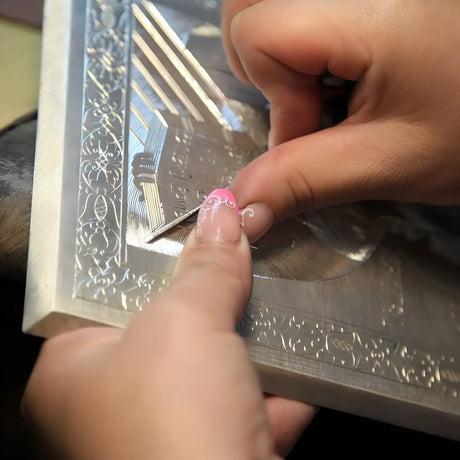
The SevChern manufactory in Veliky Ustyug — a niello city since the 17th century — has been working with this technique for 340 years. Each piece goes through 15 work steps: engraving, niello inlay, firing, grinding, polishing. The manufactory's production volume remains deliberately small — reordering is possible, but each piece carries the care of an individual. The result is not a mass-produced item — it is an object that carries time within its material.

Tradition Meets North — UNESCO Heritage and Russian Niello

On December 5, 2013, UNESCO added Turkish coffee culture to its list of Intangible Cultural Heritage. Not just because of the drink itself — but because of everything that goes with it: hospitality, engagement rituals in which mocha plays a symbolic role, coffee ground reading (fal). Coffee in the Turkish context is communication.

The connection between Ottoman coffee culture and Russian niello craftsmanship grew geographically and historically. The Crimean Khanate was an Ottoman vassal until 1783. The Caucasus was a bridge region between both worlds — a Russian-Turkish bridge evident in technique, form, and aesthetics. Niello craftsmanship traveled as a technique, not as a document — from hand to hand, from generation to generation. What is crafted today in Veliky Ustyug in northern Russia carries a lineage that dates back to this connection.

The Ottomana line consciously embodies this dual character: Ottoman Cezve form, Russian niello manufactory. Two traditions, one object.

Engraving & SilberVerse Card

The Ottomana Cezve Niello can be individually engraved upon request — a name engraving, a date, a dedication, or a pair of initials. Also available as a custom-made item with a personal text. An engraved silver Turkish coffee pot goes from being a gift to a unique piece that remains connected to the recipient — as an heirloom that is passed on.

Upon request, we include a personalized SilberVerse card in photo format (10×15 cm) — individually designed, suitable for the occasion, and currently free of charge. Whether as a wedding gift for a silver or golden wedding anniversary, as a men's gift for a milestone birthday, as a VIP gift for corporate gift-givers, or as a collector's acquisition for lovers of Russian silver art: the card is created specifically for this moment and is a unique piece that does not exist a second time. Simply specify in the order field for whom and for what occasion — we will get in touch.

At a glance

✦ Material: 925 Sterling Silver
✦ Technique: Hand engraving with niello inlay
✦ Collection: Ottomana (Niello variant)
✦ Form: Classic Cezve silhouette with beech wood long handle
✦ Dimensions: L240 × D91 × H146 mm
✦ Capacity: 370 ml
✦ Serves: 3–4 Turkish mocha cups (à 60–70 ml)
✦ Weight: approx. 246 g
✦ Manufacturer: SevChern, Veliky Ustyug
✦ Engraving: customizable upon request
✦ Delivery: in gift packaging
✦ Hallmark: confirms 925 fineness and manufacturer

Frequently Asked Questions about the Ottomana Cezve Niello

How many cups does the Ottomana Cezve hold?
The Ottomana holds 370 ml and is sufficient for 3 to 4 Turkish mocha cups. In Turkish, it is referred to as a "4-lük" Cezve — a pot designed for four Fincans (60–70 ml each). It is ideal for two people who each drink two mokkas.

Can I use the silver Turkish coffee pot on an induction hob?
No. Silver is not magnetic and therefore does not work on induction cooktops. The Ottomana Cezve is suitable for gas, electric, ceramic, open flame, and sand bath (kum kahvesi). For gas hobs: The flame must never be wider than the base of the Cezve — a corresponding warning label is included with the item.

What is the difference between the Niello variant and the Pure Cezve SW10185?
Both Cezves share the same shape, the same ornament, and the same manufactory. The difference is purely aesthetic: The Pure variant leaves the pattern in silver — monochromatic, quiet. The Niello variant fills the ornament with black niello melted in — a dramatic black-silver contrast. Neither is better or worse; it's a choice between silence and presence. Both variants can be found in our Silver Coffee Pot Collection.

Does Niello tarnish or fade over time?
No. Niello is not a coating, but an alloy that is chemically and physically bonded to the silver. It does not flake off or fade. On the contrary: With each polishing of the silver, the contrasts deepen — the surrounding silver becomes brighter, while the niello remains black. Niello becomes more beautiful over time, not worse.

How do I properly care for the silver Cezve?
Hand wash only — no dishwasher. Clean the body with a silver polishing cloth; niello does not tarnish and requires no special treatment. Never immerse the beech wood handle in water. Every 6 to 12 months, lightly rub the handle with walnut oil to prevent the wood from drying out. Further care instructions can be found in our Silver Care section.

Is the Cezve suitable as a gift — and for what occasions?
Absolutely. The silver Turkish coffee pot with niello ornament is a lasting gift. It is suitable as a wedding gift for coffee lovers, as an anniversary gift for special milestones, as a birthday gift for people with an appreciation for aesthetics, and as a housewarming gift for a new kitchen that needs character. With optional engraving and a SilberVerse card, it becomes completely personal. Further gift ideas for special occasions can be found in our Men's Gifts Collection.

Can I have the Cezve engraved?
Yes, upon request. A name, a date, a pair of initials — indicate your wish in the order field, and we will contact you. With engraving, the Ottomana Cezve becomes a unique piece that bears the recipient's name.

Where does the Cezve come from and who makes it?
The Ottomana Cezve Niello is manufactured by SevChern in Veliky Ustyug (Russia). SevChern represents a 340-year-old niello tradition — each piece undergoes 15 steps from engraving to polishing. Veliky Ustyug is considered one of the centers of Russian niello craftsmanship. You can learn more about the technique in our Niello Collection.

Black niello. White silver. 370 ml for the best morning ritual.

Engraved upon request. With a personalized SilberVerse card. Delivered in gift packaging.

To the Silver Coffee Pot Collection

Payment & Security

Payment methods

  • American Express
  • Apple Pay
  • Bancontact
  • EPS
  • Google Pay
  • iDEAL Wero
  • Klarna
  • Maestro
  • Mastercard
  • MobilePay
  • Shop Pay
  • Union Pay
  • USDC
  • Visa

Your payment information is processed securely. We do not store or access your credit card information.

💯 Our safety guarantee

With us, you pay just as securely as with PayPal - with all payment methods:
Klarna offers full buyer protection
Credit cards are protected by Visa/Mastercard
Apple Pay & Google Pay with maximum security
All transactions are encrypted according to bank standards.