Kiddush Set 925 Sterling Silver Signature23 — Goblet and Plate, partially gold-plated
Advantages
- Free domestic delivery (Germany)
- Secure purchase process
- Fast guest check-out
- Attractive prices
- 30-day return policy
- Engraving Service
Shipping & Delivery Times
The following conditions apply:
The goods are delivered worldwide.
Shipping costs (including VAT)
Domestic deliveries (Germany):
We do not charge shipping costs.
Deliveries abroad:
We charge a flat rate for shipping abroad as follows:
Zone 1: €19.00
Shipping within Europe: (Belgium, Denmark, France, Italy, Luxembourg, Netherlands, Poland, Portugal, Spain, Czech Republic, Austria)
Zone 1 non-EU: €25.95
Shipping to non-EU member states (Great Britain, Liechtenstein, Norway, Switzerland)
Zone 2 - Rest of the World: €49.00
(USA, Canada, North African territories, Middle East, parts of Asia, China, Hong Kong)
Delivery times
Unless otherwise specified in the respective offer, delivery of the goods will take place within Germany within 3 - 5 working days, and for deliveries abroad within 5 - 7 working days after conclusion of the contract (if advance payment has been agreed, after the date of your payment instruction).

Kiddush Set 925 Sterling Silver Signature23 — Goblet and Plate, par...

Highlight Title
Special properties of products
Description
This set is recognizable at first glance: golden acanthus leaves emerging from dark patinated silver. For gilded pieces, joint production pays off particularly well — the gold application is equally strong on both parts. If purchased separately, the tones may subtly differ, noticeable only when both are placed side by side.
At a Glance
- Kiddush set in 925 sterling silver: cup and plate
- Cup approx. 9 cm, plate approx. 20.5 × 20.5 cm — total silver weight approx. 0.795 kg
- Partially gilded acanthus leaves on a dark patinated background
- Cup interior fully gilded
- Plate with a round indentation for the cup stand
- Zaramella Argenti, Padua — Manufacture since 1948
Partial gilding — what it is
In this set, not the entire piece is gilded, but only individual sections: the acanthus leaves. The technical term for this is partial gilding — also known as parcel-gilt in silversmithing.
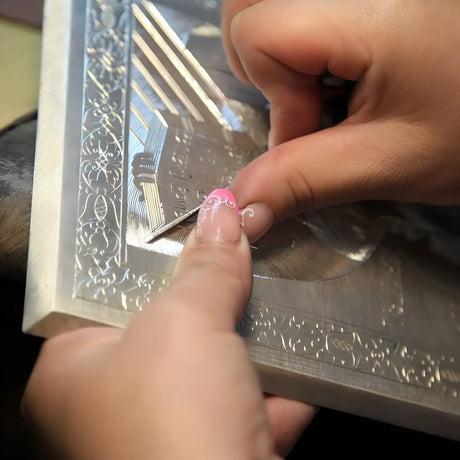
The technique requires two steps. First, the piece is completely chased, then the areas that are to remain silver are masked, and only the exposed parts are gilded. Each leaf edge must be cleanly delineated; if the gold bleeds, the work is ruined.
The effort explains the price difference compared to the monochrome models of the same line.
The Dark Background
Between the tendrils, the silver appears significantly darker than on the raised areas. This is oxidation: the indentations are deliberately darkened to give the pattern depth and to make the gilded leaves stand out even brighter against them.
Without this contrast, such a densely chased ornament would visually merge – especially by candlelight. The dark zones are therefore not tarnish and not a defect, but intentional. They should be preserved during polishing; whoever cleans them away deprives the piece of its definition.
Cup and Plate as a Unit
The plate has a round indentation in the center, where the cup sits. This is more than mere ornamentation: during Kiddush, the cup is filled to the brim, and any overflow collects in the hollow instead of on the tablecloth. The cup also won't slide even when the plate is lifted.
Both parts are crafted to match each other — the same leaf shape, the same gilding zone, the same degree of patination. Pieces from different series purchased individually would not achieve this look.
Material and Origin
The advantage of solid silver over silver-plated goods is doubly evident in a cup: chasing is only possible in solid silver — a plating would tear when worked — and the interior gilding protects precisely where polishing is not possible. A cup that is filled for decades needs both. The Italian hallmark of the manufacturer indicates the material.
Zaramella Argenti has been manufacturing in Padua since 1948. The Signature line is the richly chased hallmark of the house; the Signature23 execution is its most elaborate variant with partial gilding.
The Kiddush
The Kiddush — "sanctification" — ushers in Shabbat and holidays. The blessing is recited over a cup of wine, after which it is drunk and the cup is passed around.
A set like this takes center stage on the table. It is used weekly and is therefore designed for use: solid silver, gilded interior, no delicate attachments.
As a Gift
For a wedding, when a new household is established and needs its first ritual objects. For a Bar or Bat Mitzvah. A complete set is the gift for the occasion where completeness matters — and it can be contributed to by several givers.
Engraving
The smooth indentation of the plate and the base rim of the cup can accommodate an engraving. In sets, often only one part is engraved — usually the plate, so that the cup remains untouched. We will discuss this with you beforehand. Upon request, we will include a SilberVerse card, 15 × 10 cm, currently free of charge.
Care
By hand with warm water, mild dish soap, and a soft cloth, then dry thoroughly – including the inside of the cup. No dishwasher. Do not use polishing paste on the dark areas: It would remove the intentional oxidation and make the ornament appear flat. A soft silver cloth on the raised surfaces is sufficient. On the gilded leaves, also only wipe dry – gold is soft. More in the guide on the care of silver cutlery and tableware.
Frequently Asked Questions
Are the dark spots tarnish?
No. They are intentionally oxidized to give the ornament depth and make the gilded leaves stand out. They are part of the piece and should not be polished away.
Will the gilding wear off?
Not with normal use. The leaves are raised and are only wiped dry when cleaning. Abrasive cleaners and polishing paste should be avoided.
Is the set food-safe?
Yes. 925 silver is suitable for food contact, and the gilded interior of the cup further separates the wine from the metal.
Is the set kosher?
We carry silver ritual objects and describe their use — we cannot provide halachic information. Questions about ritual suitability should be answered by your community.
Are the cup and plate available separately?
Yes — the cup, approx. 9 cm and the plate, approx. 20.5×20.5 cm. As a set, both come from the same production, which ensures a consistent gold tone for gilded pieces.
What the set consists of
The partially gilded cup, approx. 9 cm and the partially gilded plate, approx. 20.5×20.5 cm — both from the Signature 23 model group, and both also available separately.
For gilded pieces, joint production pays off particularly well: the gold application is equally strong on both parts. If the cup and plate are purchased separately and at different times, the tones may vary slightly — which is only noticeable when both are placed side by side.
The plain alternative without gold is the Kiddush set with the footed cup. Those looking for a Seder table rather than Shabbat will find the corresponding sets among the partially gilded Eliyahu sets.
As a partially gilded set, this is also a piece to behold. Arranged cup on plate, on a dresser or in a lit display cabinet, the gold accent appears stronger than in daylight on the table — and because the set is used weekly, it belongs in an easily accessible place anyway.
You might also be interested in
More ritual items in the Judaica in 925 silver category, the entire line under Signature by Zaramella. The Friday evening when this set is used is described in Silver at the Jewish Table.
Payment & Security
Payment methods
Your payment information is processed securely. We do not store or access your credit card information.
💯 Our safety guarantee
With us, you pay just as securely as with PayPal - with all payment methods:
✓ Klarna offers full buyer protection
✓ Credit cards are protected by Visa/Mastercard
✓ Apple Pay & Google Pay with maximum security
All transactions are encrypted according to bank standards.