Silver vase 925 silver signature amphora — approx. 38 cm, openwork
Advantages
- Free domestic delivery (Germany)
- Secure purchase process
- Fast guest check-out
- Attractive prices
- 30-day return policy
- Engraving Service
Shipping & Delivery Times
The following conditions apply:
The goods are delivered worldwide.
Shipping costs (including VAT)
Domestic deliveries (Germany):
We do not charge shipping costs.
Deliveries abroad:
We charge a flat rate for shipping abroad as follows:
Zone 1: €19.00
Shipping within Europe: (Belgium, Denmark, France, Italy, Luxembourg, Netherlands, Poland, Portugal, Spain, Czech Republic, Austria)
Zone 1 non-EU: €25.95
Shipping to non-EU member states (Great Britain, Liechtenstein, Norway, Switzerland)
Zone 2 - Rest of the World: €49.00
(USA, Canada, North African territories, Middle East, parts of Asia, China, Hong Kong)
Delivery times
Unless otherwise specified in the respective offer, delivery of the goods will take place within Germany within 3 - 5 working days, and for deliveries abroad within 5 - 7 working days after conclusion of the contract (if advance payment has been agreed, after the date of your payment instruction).

Silver vase 925 silver signature amphora — approx. 38 cm, openwork

Highlight Title
Special properties of products
Description
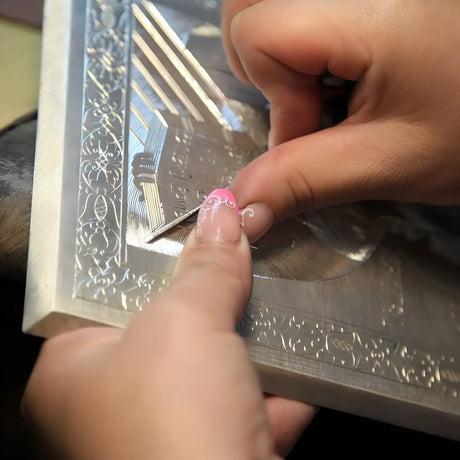
Two raised handles, an openwork belly, a mouth that opens like a calyx. The à-jour work is the most elaborate technique Signature uses: each perforation is sawn and reworked by hand. Among the vases in the line, this is the only one with this technique.
At a Glance
- Two-handled amphora vase made of 925 sterling silver
- Height approx. 38 cm, width approx. 29 cm — silver weight approx. 2.0 kg
- Belly partially openwork (à jour)
- Two high-curved handles with acanthus volutes
- Calyx-shaped mouth, gilded inside
- Ribbed base on a chased foot
- Zaramella Argenti, Padua — Manufacture since 1948
Openwork
The belly of this vase is not only chased but also partly openwork — the technical term for this is à jour. Sections are completely sawn out between the tendrils, so you can see through them.
This is the most demanding technique on the piece. Each perforation removes material from the body and thus stability; the remaining webs must bear the shape alone. If too much is removed, the vessel will warp during further working. Therefore, the perforations are located where the curve supports itself, and the load-bearing axes remain closed.
Visually, this changes everything: light not only falls on the vase but also passes through it. In front of a window or next to a lamp, it casts a pattern on the surface behind it.
The Amphora Shape
Two raised handles, a bulbous body, a slender neck — the amphora is one of the oldest vessel forms in Europe and entered silver through the Renaissance. The handles swing far beyond the shoulder and end in rolled acanthus volutes; here, they are no longer a carrying handle but a form.
At approx. 29 cm wide, the piece is significantly more expansive than the baluster vases in the line. It needs space around it and looks better on a wall or in a niche than free-standing in a passageway.
The Mouth
At the top, the vase opens into a flat, flared calyx with a wavy rim, gilded inside. Gold does not react with water or moisture; the inside does not tarnish. Viewed from above, a warm tone lies in the silver, emphasizing the opening.
Material and Origin
Solid silver is a prerequisite here, not an embellishment: the chasing would not be possible on a plating — it would tear during working. Solid silver can also be repolished for generations without thinning. Hallmarked by the manufacturer in Italy.
Zaramella Argenti has been manufacturing in Padua since 1948. The Signature line is the richly chased signature of the house.
Where it Stands
On the console, in the display cabinet, in a wall niche. Because of the perforations, it benefits from places with light from behind or from the side — in front of a window, next to a lamp.
As a flower vase, it should be used with care: the openwork parts are above the water-bearing zone, but it should not be filled deeply. For a flat, wide bouquet, the wide mouth is ideal. Many deliberately display it empty — with this piece, the wall itself is the motif.
Engraving
The ribbed base and the smooth zones below the handles can accommodate a subtle engraving. The openwork belly is excluded. We will advise you on placement and size upon request. Upon request, we will include a SilberVerse card, 15 × 10 cm, currently free of charge.
Occasions
For a golden wedding anniversary, as an honorary gift, for a major anniversary. A piece with openwork is a handicraft piece in the narrower sense — it is suitable where the effort itself is the message.
Care
Wash by hand with warm water, mild detergent, and a soft cloth, then dry thoroughly. No dishwasher. Work carefully with the openwork parts — the webs are load-bearing but not designed for tension; do not pull on them or lift the piece by them. The vase is carried by the body, not by the handles. Tarnishing is normal and reversible with a silver cloth; the darker depth may remain in the tendrils. More in the guide on caring for silver cutlery and silverware.
Frequently Asked Questions
Is the vase watertight?
The lower part of the body is closed and holds water. The openwork parts are above it. Do not fill up to the ornamental zone.
Can I carry it by the handles?
Better not. The handles are form, not carrying handles. Carry the piece by the body.
What does "openwork" mean?
Parts of the wall are sawn out, so you can see through them. Technically à jour. It is the most elaborate technique on the piece.
Solid or silver-plated?
Solid 925 sterling silver with a gilded mouth, no silver plating. With official Italian hallmark.
Does the manufacturer list it as a ritual object?
In their catalog, it is listed under religious objects. It does not have a specific ritual feature — its form is that of a flower vessel. Actual ritual silver of the line can be found in the category Judaica made of 925 silver.
Is it delivered in gift packaging?
Yes, in high-quality packaging from the manufacturer.
The Smallest and Most Unique of the Three
At approx. 38 cm, this amphora is the smallest vase in the line — and the only one with à-jour work: parts of the wall are perforated, allowing light to pass through. This is the most elaborate technique that Signature uses, as each perforation is sawn and reworked by hand.
The closed alternatives are the baluster vase and the chased vase, both approx. 46 cm.
A note on origin: The manufacturer lists this model in its catalog under religious objects. The vase does not have a specific ritual feature — an inscription, a prescribed measure —; its form is that of a flower vessel. Those looking for ritual silver will find it in the category Judaica made of 925 silver.
You Might Also Be Interested In
More vessels in Carafes & Jugs, the entire range in Table Silver & Silverware, plus Silver Trays.
Payment & Security
Payment methods
Your payment information is processed securely. We do not store or access your credit card information.
💯 Our safety guarantee
With us, you pay just as securely as with PayPal - with all payment methods:
✓ Klarna offers full buyer protection
✓ Credit cards are protected by Visa/Mastercard
✓ Apple Pay & Google Pay with maximum security
All transactions are encrypted according to bank standards.