Challah Plate 925 Sterling Silver Signature — approx. 48.5×36 cm
Advantages
- Free domestic delivery (Germany)
- Secure purchase process
- Fast guest check-out
- Attractive prices
- 30-day return policy
- Engraving Service
Shipping & Delivery Times
The following conditions apply:
The goods are delivered worldwide.
Shipping costs (including VAT)
Domestic deliveries (Germany):
We do not charge shipping costs.
Deliveries abroad:
We charge a flat rate for shipping abroad as follows:
Zone 1: €19.00
Shipping within Europe: (Belgium, Denmark, France, Italy, Luxembourg, Netherlands, Poland, Portugal, Spain, Czech Republic, Austria)
Zone 1 non-EU: €25.95
Shipping to non-EU member states (Great Britain, Liechtenstein, Norway, Switzerland)
Zone 2 - Rest of the World: €49.00
(USA, Canada, North African territories, Middle East, parts of Asia, China, Hong Kong)
Delivery times
Unless otherwise specified in the respective offer, delivery of the goods will take place within Germany within 3 - 5 working days, and for deliveries abroad within 5 - 7 working days after conclusion of the contract (if advance payment has been agreed, after the date of your payment instruction).

Challah Plate 925 Sterling Silver Signature — approx. 48.5×36 cm

Highlight Title
Special properties of products
Description
Two braided loaves in relief and two Hebrew lines running around the edge: This plate shows what it's made for without needing to ask. On Shabbat, two challahs are placed on the table — the common interpretation refers to the double portion of manna that fell to the people in the desert on Friday.
At a glance
- Challah plate made of 925 sterling silver
- Dimensions approx. 48.5 × 36 cm — silver weight approx. 1.11 kg
- Two braided loaves in relief, crafted in the center
- Two circulating Hebrew lines: Shabbat commandment and bread blessing
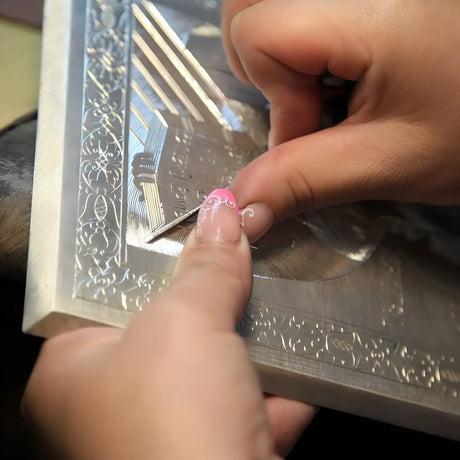
- Border with grape and tendril ornament, chased
- Zaramella Argenti, Padua — Manufacture since 1948
Why two loaves
On Shabbat, there are always two braided loaves on the table, never one. They are called Lechem Mishneh, "double bread," and commemorate the double portion of manna that was gathered in the desert on the sixth day — enough for Friday and Shabbat, when no gathering took place.
The two loaves also represent two words: Zachor and Shamor — "Remember" and "Observe." This is how the Shabbat commandment begins in its two transmitted versions.
That is why this plate features two loaves and not one. It is not a decorative motif, but a count.
The two lines
Two Hebrew inscriptions run around the relief. One contains the Shabbat commandment — "Remember the Shabbat day, to keep it holy." The other, the bread blessing, Hebrew HaMotzi: "...who brings forth bread from the earth."
Thus, the plate bears the two sentences that are spoken at this point of the evening. It is not just a base, but part of the ritual — like the Seder plate for Passover, which bears the names of its foods.
The cloth
The challahs remain covered until after the blessing, usually under their own cloth. This also goes back to the manna: it lay between two layers of dew — the tablecloth represents the lower layer, the challah cloth the upper.
The plate is built accordingly. Its surface is even enough for a cloth to lie smoothly over it, and the rim is kept flat so that it does not rest on or slip.
The size
Approx. 48.5 × 36 cm is generous — two grown challahs need space, and they should lie next to each other, not on top of each other. The oval shape accommodates the elongated form of the braided loaves; a round plate would waste space at the ends.
At approx. 1.11 kg, it lies steadily on the table, even if pressure is applied to one side during cutting.
Material and origin
For a piece that is passed down through generations, the difference from silver-plated goods is crucial: a plating wears off, solid silver does not. It can be polished again and again, and the ornament — which can only be worked in solid silver — remains intact. The Italian hallmark certifies it.
Zaramella Argenti has been manufacturing in Padua since 1948. The rim features a densely chased band of grapes and tendrils — hand-punched into the silver. The loaves in the center are plastically worked, with a recognizable braided pattern.
As a gift
For a wedding, when a household is created and celebrates Shabbat for the first time. A challah plate is one of the first pieces needed — unlike equipment for individual holidays, it is on the table every week.
For a housewarming, a Bar or Bat Mitzvah. And as a gift for hosts who regularly invite guests: whoever gives it shows that they know the tradition.
Engraving
The smooth rim between the relief and the ornamental band accommodates a dedication. Because the plate already bears two Hebrew lines, we recommend a restrained engraving — a date, a name — instead of another long line. We will coordinate this with you in advance. Upon request, we will include a SilberVerse card, 15 × 10 cm, currently free of charge.
Care
By hand with warm water, mild dish soap and a soft cloth, then dry thoroughly — also in the letters and the braided pattern of the loaves. No dishwasher: cleaning salts attack silver. Promptly remove crumbs and salt; salt attacks silver, and there is usually some available at the Shabbat table. Tarnishing is reversible with a silver cloth; in the letters and depressions, the darker depth can remain — there it makes the writing legible. More in the guide on the care of silver cutlery and silverware.
Frequently asked questions
Why are two loaves pictured?
On Shabbat, there are always two challahs on the table — Lechem Mishneh, the double bread. It commemorates the double portion of manna on the sixth day and stands for "Remember" and "Observe."
What do the Hebrew lines say?
One contains the Shabbat commandment, the other the bread blessing HaMotzi — the two sentences spoken at this point.
Do two large challahs fit on it?
Yes. At approx. 48.5 × 36 cm, two grown loaves lie next to each other.
Can I put a cloth over it?
Yes, the plate is built for that: flat surface, flat rim, so the cloth lies smoothly.
What else belongs on the same table?
A Kiddush cup for the blessing over the wine, the Netilat vessel for washing hands, and candlesticks, traditionally placed in pairs.
Is it delivered in gift packaging?
Yes, in high-quality packaging from the manufacturer.
Is it kosher?
We sell silver items and describe their use — we cannot provide religious legal information. Questions about ritual suitability should be answered by your community.
What belongs on the same table
The Challah plate holds the two braided loaves over which the blessing is said at the beginning of the Shabbat meal. Measuring approximately 48.5×36 cm, it is designed for two large loaves.
The same setting includes:
- a Kiddush cup for the blessing over wine — or even the set of cup and plate
- the Netilat vessel for washing hands before the bread
- a candlestick, traditionally placed in pairs
For the Seder evening at Passover, the Seder plate and the Cup of Elijah are added. The complete selection is available under Judaica made of 925 silver.
A challah plate is placed on the table weekly and therefore does not need to be stored away. On a sideboard or side table, it lies between Shabbat evenings as a flat silver object — the Hebrew line on the rim and the depiction of the two loaves make it something to behold even when empty.
You might also be interested in
Other ritual objects in the category Judaica made of 925 silver, the entire line under Signature by Zaramella. Why two loaves are on the table is explained in Silver at the Jewish table.
Payment & Security
Payment methods
Your payment information is processed securely. We do not store or access your credit card information.
💯 Our safety guarantee
With us, you pay just as securely as with PayPal - with all payment methods:
✓ Klarna offers full buyer protection
✓ Credit cards are protected by Visa/Mastercard
✓ Apple Pay & Google Pay with maximum security
All transactions are encrypted according to bank standards.